What the hell is going on right now?
When everything seems to be falling apart and coming together at the same time.
Is it just me, or is everyone asking what the hell is going on right now?
Laptops dying without warning. Websites going haywire. Banking systems offline. Payments failing. Property sales that were all but signed suddenly stalling. Flights delayed, plans unravelling.
And beyond the everyday frustrations, far more serious things are unfolding. Natural disasters. Fatal accidents. Conflict. Economic instability. Communities facing loss on a scale that is hard to comprehend.
It feels as though someone has turned up the heat. And in the middle of all this, I’ve just become a grandmother.
A brand new life has arrived.
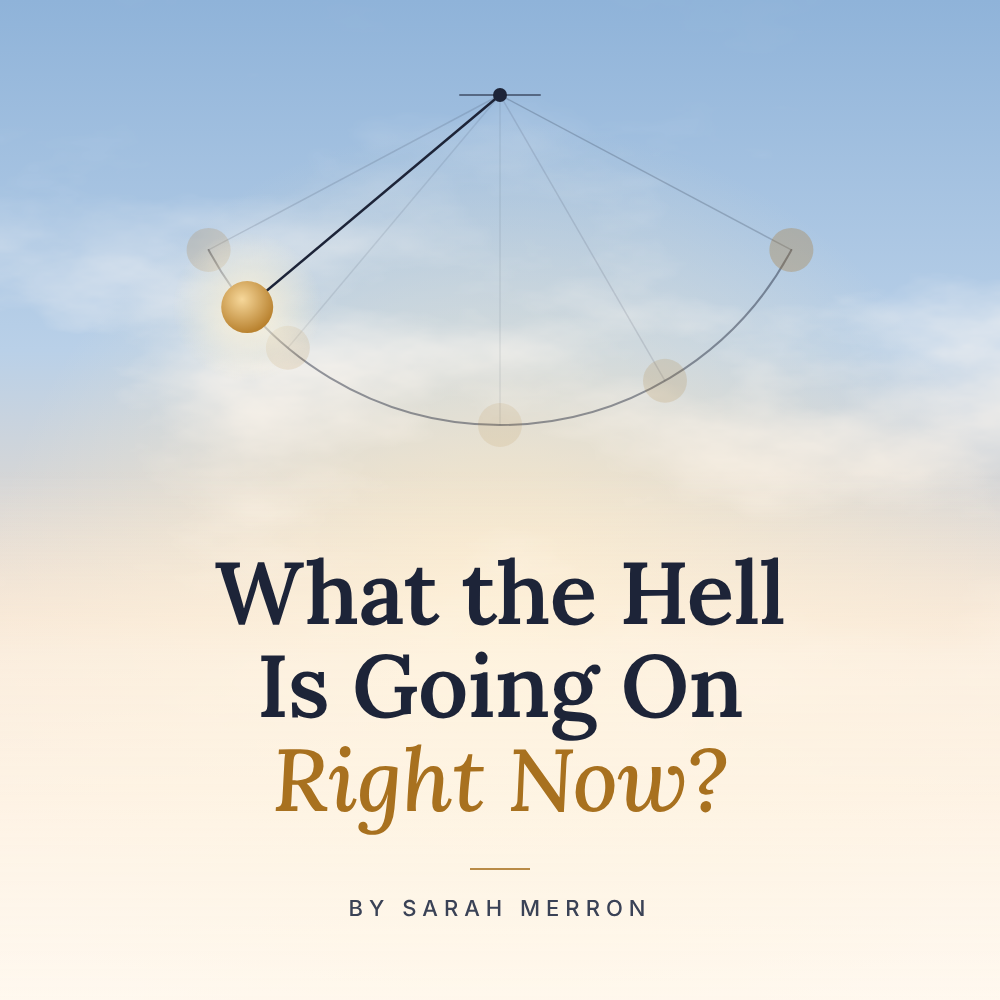
Alongside the uncertainty, there is extraordinary joy, unexpected opportunity and new beginnings that might never have happened under different circumstances. It’s as if the pendulum is swinging wider in both directions at once.
Which has left me wondering: What if the same conditions making life feel so unstable are also changing what becomes possible?
More Chaos, or More Noticing?
Before concluding that the world has gone completely mad, it’s worth asking whether we’re experiencing more disruption or simply noticing more of it.
Our brains are prediction machines. When something unexpected happens, it grabs our attention. When several unexpected things happen close together, we start seeing a pattern, and every failed payment becomes further evidence that something unusual is going on.
That doesn’t make the disruption less real. Our money exists mostly as digital information. Our businesses run on software, networks and payment providers. A single journey depends on technology, infrastructure and people all doing their part. These systems are remarkably efficient, but the same connections that make them powerful also allow problems to travel. A failure in one place can ripple out to people thousands of miles away.
Perhaps what we’re noticing isn’t the collapse of order, but the exposure of how fragile it always was. We’ve grown so used to complex systems working that we treat them as permanent features of reality, when in fact they are maintained, moment by moment, by countless things going right.
How much of what we call stability is really just our confidence that tomorrow will look like yesterday?
Not Every Disruption Is a Disaster
I want to make a clear distinction here.
A dead laptop or a collapsed deal can be frustrating and costly. But it is not comparable to a natural disaster, a fatal accident or the loss of someone you love. When families are shattered, and communities lose everything, it would be insensitive to suggest that something better must come of it. Suffering doesn’t need to be justified by a positive outcome, and not every tragedy should become a lesson in personal growth. Sometimes the right response is to grieve, support one another and rebuild what can be rebuilt.
And yet, without diminishing any of that, something important remains true:
We don’t have to believe that everything happens for a reason to recognise that what happens can change what becomes possible.
When the Future You Expected Disappears
So much of life is organised around a future we’ve already pictured. We make plans, commit, invest, and gradually our expectations become so familiar that they stop feeling like predictions and start feeling like facts.
The business will succeed.
The sale will go through.
The career will progress.
The technology will work.
Until it doesn’t.
Our first instinct is to restore what we had. Sometimes that’s exactly right. But sometimes the interruption shows us something we hadn’t seen: an assumption we never questioned, an option we’d dismissed, a direction we hadn’t imagined.
Complexity science describes something similar. Under pressure, a system might recover its old shape, deteriorate or reorganise into something entirely new. Instability doesn’t guarantee a better outcome, and it can drain resources and make it harder to act well. But it changes which patterns are viable and which possibilities come within reach. A business model stops working and makes room for a better one. A role disappears, and someone finally asks how they actually want to work.
Disruption doesn’t create a better future. It changes the conditions in which the future unfolds. That is a very different proposition.
Are We So Busy Restoring Certainty That We Miss What’s Emerging?
Imagine two people facing the same unexpected setback. Both feel frustrated, disappointed, perhaps frightened.
The first focuses on getting things back to how they were. Their attention narrows to what has gone wrong and how to regain control.
The second feels the same emotions, but starts asking different questions. What has actually changed?
Which of my assumptions no longer hold? What is still within my influence?
Which of my assumptions no longer hold? What is still within my influence?
The questions we ask shape what we notice. What we notice shapes the options we consider. And the options we consider shape what we do.
When all our attention goes into recovering the future we predicted, we can miss what matters about the future unfolding. We keep trying to recreate conditions that no longer exist, and read every unexpected development as an obstacle.
What if we’re so busy stopping things from falling apart that we never discover what might come together differently?
From Control to Agency
One of the central principles of my work with Primal Integrity™ is this: Organisation creates experience. Awareness reorganises organisation.
When something unexpected happens, we’re never just responding to the event. We’re responding to what we believe it means, what we predict will happen next, and what we think is still possible. Our whole experience can become organised around threat, loss or the urgent need to regain control. Those responses help us spot real danger, but they can also narrow our perception just when the situation calls for flexibility.
Awareness lets us separate three things: what is actually happening, what we’re predicting, and what we can genuinely influence. That isn’t about ignoring risk or pretending everything is fine.
It’s about responding to change without being governed by our first interpretation of it.
That is where agency lives. Agency isn’t the ability to control every circumstance. It’s the capacity to take a meaningful part in what happens next, whether that means changing direction, rebuilding, asking for help or accepting what is beyond our control.
And in a world that feels less predictable by the week, that capacity may be one of the most valuable things we can develop.
Life Doesn’t Wait for Everything to Settle
Which brings me back to my new grandchild.
While technology has been failing and plans have been unravelling, a new human being has arrived, full of possibilities nobody can predict.
A baby doesn’t make up for the suffering happening elsewhere. But it reminds us that life doesn’t wait for everything to be stable before something new begins.
Creation and disruption happen side by side. Joy and grief share the same world. Possibility and uncertainty were never opposites.
I don’t know whether the world is genuinely becoming more chaotic, or whether our attention has attuned to it. But the greatest opportunity in unpredictable times may not be learning to anticipate everything that comes next. It may be developing the awareness to help create what comes next, even when we can’t predict it.
What if the apparent chaos isn’t telling us what the future will look like, but revealing how much of it we’d assumed would stay the same?
Perhaps the real question isn’t whether the pendulum is swinging wider.
It’s whether we’ve grown so used to standing still that we’ve forgotten how to move with it.


