How Multitasking Makes You 40% Less Productive - and What to Do About It
How many times have you had a phone conversation while doing something else? Modern life may seem to demand multitasking, but should we succumb?
Leaders often praise multitasking as efficient—but science reveals the opposite. When we switch between tasks, each switch incurs a “switch cost”, effectively a cognitive energy hit every time attention is refocused. These gaps add up, slowing task completion and increasing errors.
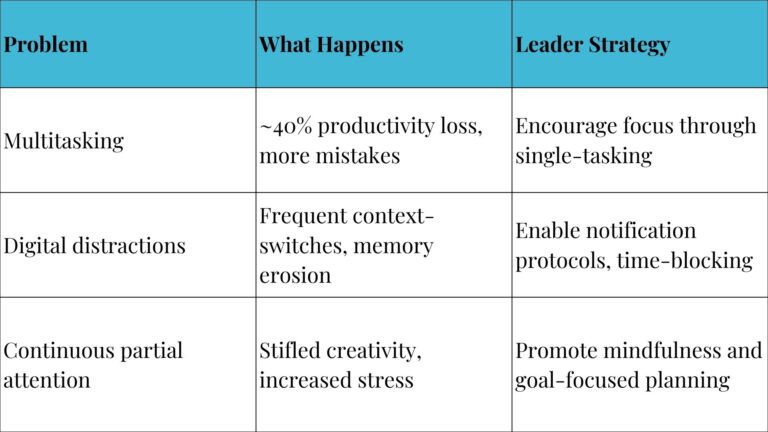
Crucially, the researchers Meyer, Evans and Rubinstein estimate these interruptions reduce productivity by roughly 40%, underscoring that multitasking is often worse than doing tasks sequentially.
Altered brain function when forced into constant task switching
These findings highlight that our brains are not built to handle multiple complex actions simultaneously – we don’t have the architecture.
Neuroscience confirms this bottleneck: key brain networks – the frontoparietal control, dorsal and ventral attention networks – are overloaded when multiple goals are active. That results in interference, slower responses, and diminished focus.
Conversely, for complex tasks – such as strategic thinking, negotiation, or problem-solving, divided attention leads to inefficiencies and mistakes.
Digital Distractions Intensify The Damage
A 2024 PMC article reported that around 40% of adults routinely multitask across digital devices, worsening productivity through constant context switching and attention fragmentation.
Interruption science shows knowledge workers switch tasks every – 3 minutes – and once interrupted, take up to 30 minutes to regain deep focus. These frequent disruptions significantly erode efficiency over a full workday.
From 'Continuous Partial Attention' to lost innovation
Linda Stone’s concept of continuous partial attention – the urge to stay plugged in to multiple information streams – leads to chronic mental fatigue. It undermines decision-making, impairs memory formation, and erodes creative thinking and team collaboration.
Supporting research highlights that heavy media multitaskers perform worse on memory tasks, slower on pattern recognition, and make more false memory errors under distraction.
What Business Leaders Can Do Instead
1. Champion single-tasking as a real productivity tool
Organisations like BrainHealth report that shifting to deliberate single-tasking – hyper-focusing on one task at a time – increases accuracy, reduces errors, and generates creativity. Employees reported becoming more productive with practice-based routines, without needing structural overhaul
2. Implement attention management strategies
Research-backed strategies include:
Time-blocking: allocate focused blocks to priority tasks.
Distraction control: disable non-essential notifications and build “distraction-free” zones.
Mindfulness training or high-intent goal-setting rituals: to strengthen attention control and reduce goal fragmentation.
3. Redesign meetings and workflows to minimise task-switching
Adopt meeting practices that reduce overload:
Schedule sensory-intense tasks before meetings
Reduce meeting size/duration
Buffer time before and after meetings to avoid context-switch fatigue.
4. Lead by example
Leaders who single-task during critical points set cultural norms. Encourage team members to:
Close email when working on high-focus deliverables
Respect time-blocks and calendar boundaries
Stop Multitasking, Start Delivering
Multitasking doesn’t scale leadership – it scatters it. Rigorous science from USC’s applied psychology, APA findings, and neuroscience confirm that focusing on one thing yields better, faster, and more creative results.
As business leaders, we can normalise attention, rather than fragmentation, and reap the performance, innovation, and well‑being rewards.
Are you ready to lead from the front and focus on single-tasking?