NLP, Mindset, and Psychology of Change: How Our Minds Create - and Can Recreate Our Reality
Our mindset isn’t something we are born with. It’s built – moment by moment, experience by experience. Through repeated patterns of thoughts, feelings, and behaviours, we construct an internal model of the world and of ourselves. The problem? Most people don’t realise they’re running an automated script based on outdated, unhelpful programming.
Neuro-Linguistic Programming (NLP) gives us the tools to break these patterns and actively rewrite stories.
Let’s discuss how this works, why it matters, and how psychology supports the idea that change is possible, even for the most deeply rooted beliefs and behaviours.
Conditioning and the Mindset Loop: How We Build Our Internal World
From the moment we’re born, we begin learning through conditioning. B.F. Skinner’s Operant Conditioning model explains how we learn behaviours through reinforcement and punishment. If a child receives praise for speaking up, they may become more confident.If they are criticised or ignored, they may develop social anxiety. These early experiences form the foundations of the mindset.
Similarly, Classical Conditioning, first described by Ivan Pavlov, helps explain emotional triggers. For example, if a child hears a parent’s angry tone every time they make a mistake, they may develop a fear response to similar tones in adulthood, even when there’s no real threat.
This creates what we call automatic scripts: patterns of response that run unconsciously, shaping our view of the world and ourselves.
Over time, these learned patterns become the “truth” of our self-perception.
Reconstructive Memory: Why Your Past Isn’t Fixed
One of the most important insights from cognitive psychology is that memory isn’t a recording – it’s a reconstruction.
According to Elizabeth Loftus, a leading researcher in cognitive psychology, our memories are malleable and easily influenced by emotion, suggestion, and current mindset.Her studies on false memoriesshow that people can be led to remember events that never actually happened, or change details of real memories based on current suggestions or feelings (Loftus & Palmer, 1974).
This means that when you think about your past, you’re not recalling an exact copy. You’re re-creating it based on who you are now, how you feel today, and the beliefs you currently hold.
In short, we don’t just remember the past – we reshape it.
For example, if you’re in a low mood, you may remember events as more negative than they were. If you’re feeling empowered, you may reinterpret past failures as lessons. This ongoing process of memory reconstruction directly reinforces your mindset.
The Mind-Body Connection: Programming Ourselves Physically and Mentally
Every thought and emotion triggers a cascade of physical responses. Your brain sends signals through neurotransmitters like dopamine, serotonin, cortisol, and adrenaline, influencing mood, energy, and behaviour.
The hypothalamic-pituitary-adrenal (HPA) axis regulates the stress response. When negative thoughts dominate, the HPA axis pumps out cortisol, creating a state of ongoing physiological stress (McEwen, 2007).
This leads to a feedback loop where thoughts create hormones, and those hormones reinforce the thoughts.
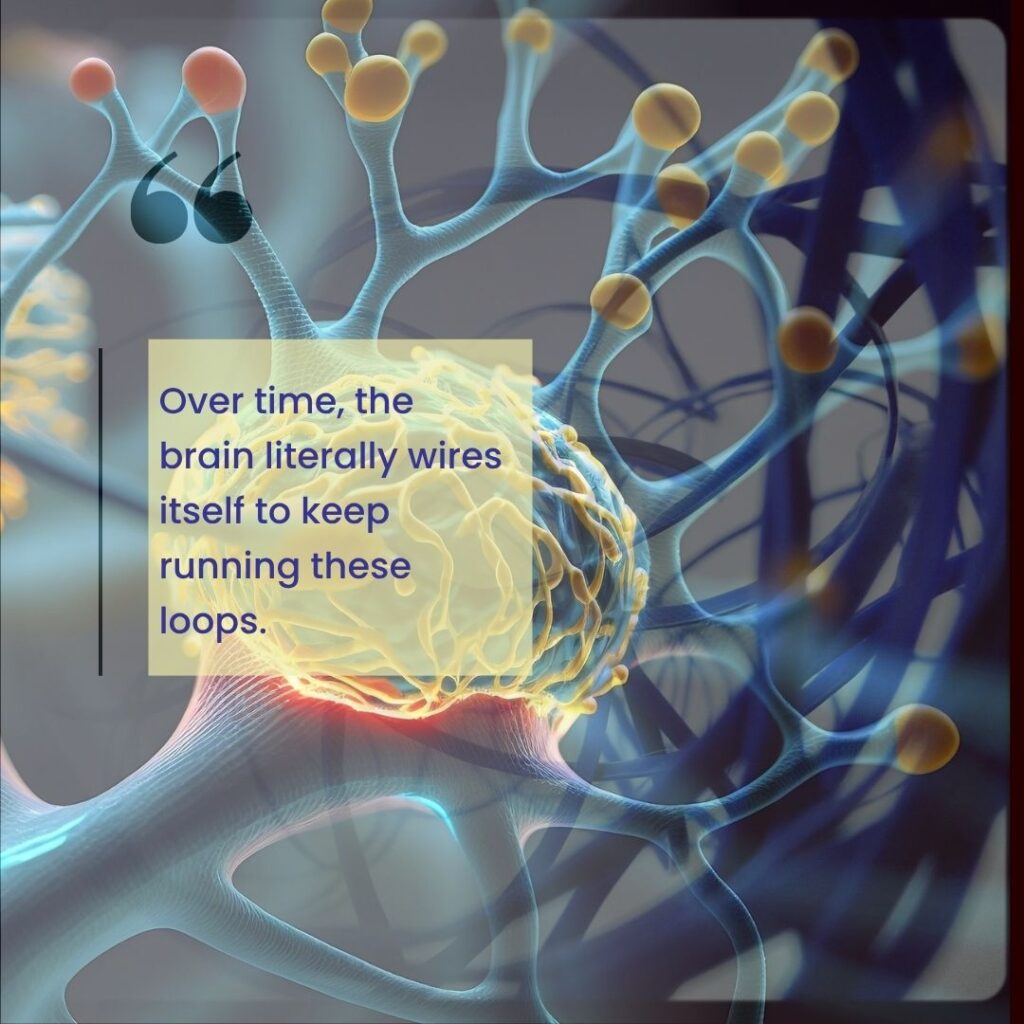
Over time, the brain literally wires itself to keep running these loops. This is neuroplasticity, the brain’s ability to rewire based on repeated experience (Hebb, 1949). In other words, the more you think a thought, the easier it becomes to repeat it.
This is why people can get stuck in self-fulfilling prophecies like:
“I always mess things up.”
“Nobody listens to me.”
“I’m not good enough.”
“I’m an anxious person.”
“I can’t understand maths.”
These are not facts. They are neural grooves worn deep through repetition. Because the body responds physically with hormones and emotions, they feel real.
NLP: Pattern Interrupts and Rewiring the Mind
Neuro-Linguistic Programming (NLP) works by disrupting these automatic loops and creating new pathways.
Richard Bandler and John Grinder, the founders of NLP, observed how therapists like Virginia Satir and Milton Erickson helped people change quickly, not by digging through trauma endlessly, but by shifting how the brain stores and processes experience.
One of NLP’s key strategies is the pattern interrupt. When someone is stuck in a negative thought or behaviour loop, NLP techniques introduce a break in the pattern. This could involve changing submodalities (the way the brain codes sensory information), anchoring positive emotional states, or reframing the story.
For example, if a client repeatedly visualises failure in vivid colour, NLP may help them shrink the image, turn it black and white, and push it far into the distance. The emotional charge reduces, and new options become possible.
This isn’t “tricking the brain” – it’s using its natural plasticity to retrain perception.
Anchoring: Why We Stay Stuck (and How to Change It)
Another powerful NLP concept is anchoring, which explains how emotional responses become linked to specific triggers.
Pavlov’s dog experiment is a classic example of an anchor: the bell became linked to food, causing salivation. In human terms, a song, smell, or tone of voice can trigger emotional states instantly.
So, how could this pose a problem? Many people unconsciously anchorstress responsesto everyday situations—public speaking, a family member’s comment, or even checking email.
NLP teaches people how to re-anchor these states consciously. For example, you can create a resource anchor – a trigger that brings up confidence or calm when needed.
This is part of breaking the loop: you stop being a victim of automatic reactions and start choosing your responses.
Time Is an Illusion: Why Change Can Influence the Past and Future
One of the most profound insights in both NLP and modern psychology is that time is subjective.
Einstein’s theory of relativity proved that time is not a constant. It changes depending on speed, gravity, and perception. From a psychological perspective, time is even more fluid.
The unconscious mind doesn’t know the difference between past, present, and future in the same way the conscious mind does. That’s why you can have a stress response today to something that happened years ago—or to something that hasn’t happened yet.
Time Line Therapy®, developed by Tad James, uses this principle to help clients reprocess past events and change how they are stored in the mind. By shifting perception, you can influence how the body responds in the present, even to events long gone.
This is not just theoretical. Research on mental time travel (Suddendorf & Corballis, 2007) shows that humans have a unique ability to imagine themselves in the past or future, altering decisions and behaviours based on those imagined scenarios.
If you change your memory of an event (how it’s stored and the meaning you give it), you change the physiological and emotional response in the present.
In this sense, healing the past isn’t about changing what happened, but changing the imprint it left on the mind and body.
Why Understanding This Matters
When you understand that:
Your memories are malleable
Your emotions create physiological patterns
Your thoughts reinforce neural pathways
Your unconscious mind operates outside of linear time
…you realise that change is not only possible, it’s essential for growth.
Staying in old patterns is like running outdated software on new hardware. It’s inefficient, frustrating, and limits potential.
NLP provides the tools to:
Identify limiting beliefs, unhelpful emotions and thought patterns
Break the loop through pattern interrupts
Re-anchor emotional states for empowerment
Reframe the meaning of past events
Access resources from the future self
By doing this, you create a new mindset that supports flexibility, resilience, and growth.
The Science of Possibility
Modern neuroscience, psychology, and quantum theory are aligning with ancient wisdom and NLP principles:
Neuroplasticity tells us the brain can change at any age (Doidge, 2007).
Epigenetics shows that thoughts and environment can influence gene expression (Lipton, 2005).
Cognitive behavioural studies confirm that changing thought patterns changes behaviour (Beck, 1976).
Mindfulness research supports the idea that perception shapes reality (Kabat-Zinn, 1990).
When you combine these insights with NLP, you gain a toolkit not just for coping, but for consciously creating your experience of life.
NLP Is A "Do With" Process, Not A "Do To" Process.
The goal is to partner with the client, guiding them to access unconscious patterns, bring them into conscious awareness, and develop the tools to break and redirect those patterns.
In NLP, the client learns to shift their thoughts toward more resourceful, helpful options, not through force, but by changing their internal representations. This might involve recalling a positive memory to change an emotional state, creating excitement about a future possibility, or reprogramming the way the client experiences a problem.
The unconscious mind does much of the work during an NLP session, but lasting change happens when the client actively consolidates these shifts – practising new responses and reinforcing them over time.
Successful clients are willing to collaborate with a coach or therapist to create real, sustainable change.